I was engaging in interesting discussion with my colleague about marriage percentage in Japan before I went back to my home while waiting the stormy weather stop. Our discussion mostly was about why the marriage rate in Japan became declining, especially in Heisei era and even in Reiwa Era. Based on https://www.stat.go.jp/english/data/handbook/c0117.htm, In 2019, 598,965 couples married, and the marriage rate was 4.8. The mean age of first marriage was 31.2 for grooms and 29.6 for brides in 2019. The mean age of first marriage for grooms rose by 2.5 years, while that of brides rose by 2.8 years over the past 20 years (in 1999: grooms, 28.7; brides, 26.8). In addition, there has been an increasing trend in the proportion of those who have never married until he or she turns the exact age 50, reaching 23.4 percent for males and 14.1 percent for females in 2015, the highest percentages ever.
What is Heisei and Reiwa Era?
Well, lets start from a definition of Reiwa Era, and Heisei Era, because that is the things that I mentioned in the beginning of this blog paragraph, and maybe u, as a people who not living in Japan, never know about this term. Well, in Japan, there are 2 ways to write their calendar system. First is English way, 2nd is Japanese way. So, as you already predicted, Heisei and Reiwa are some of the calendar system in Japanese way. The name of the year is depending on who is the emperor that is running Japan imperium. Heisei Era is started from January 8th, 1989 until April 30th, 2019 (the emperor is Emperor Akihito) . Then from May 1st 2019 we called it as Reiwa Era (the emperor is Emperor Naruhito). note : Since I am still living in Japan, I am not daring to mention those previous names just by the name, and I don’t think adding “sama” after their name is a correct way.)
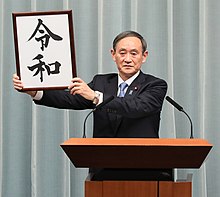
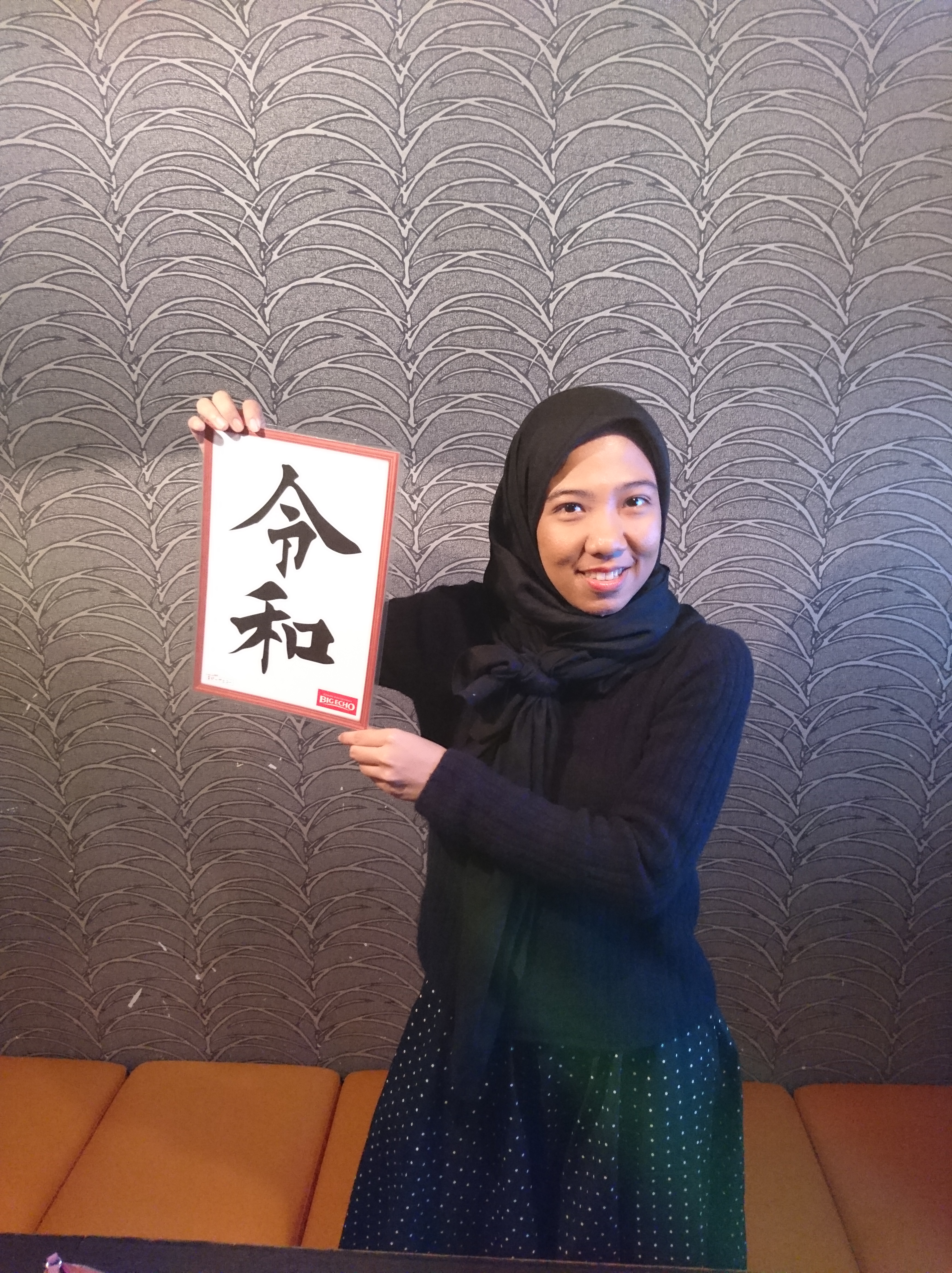
Picture on the left side was taken from https://en.wikipedia.org/wiki/Reiwa. Right picture is the author who tried to imitate the left picture with a dazzling light attack to her eyes.
The Definition of marriage on this article
The second, lets we define what is marriage definition in Japan. Defining the terms that we are going to discuss is one of crucial part in a discussions as scientist. Cause if we have different definition, our point of view maybe will never be on the same page.
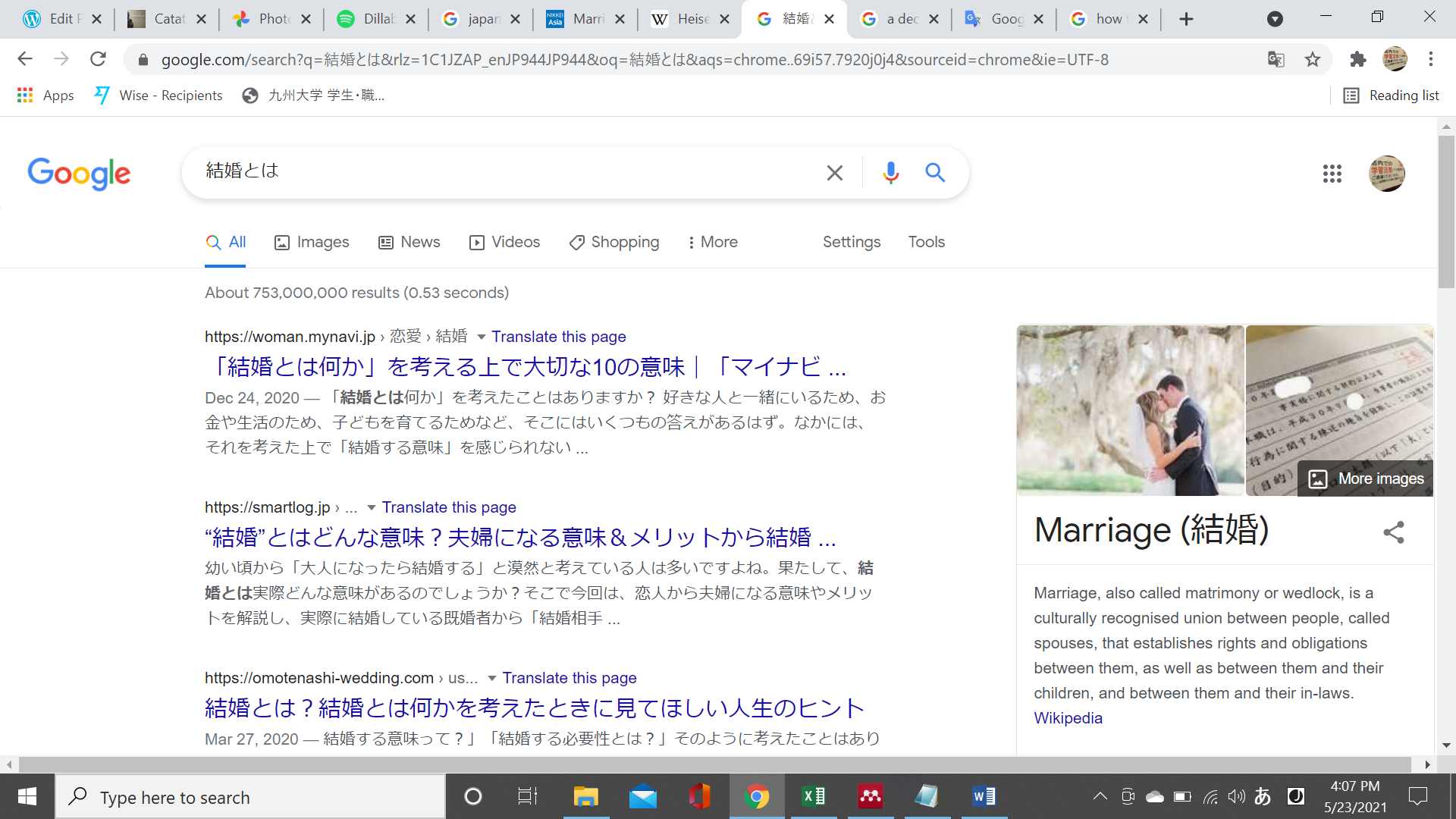
Me and my colleague who discussed with me in that time define a marriage as the process of a couple in legalizing their sexual relationship under the umbrella of state law, and the child born during that period is recognized as an legitimate child under the law. So just in case, if you are my reader and starting to give another explanation about marriage, I already locked the meaning of marriage definition on this article.
Declining rate of marriage in Japan
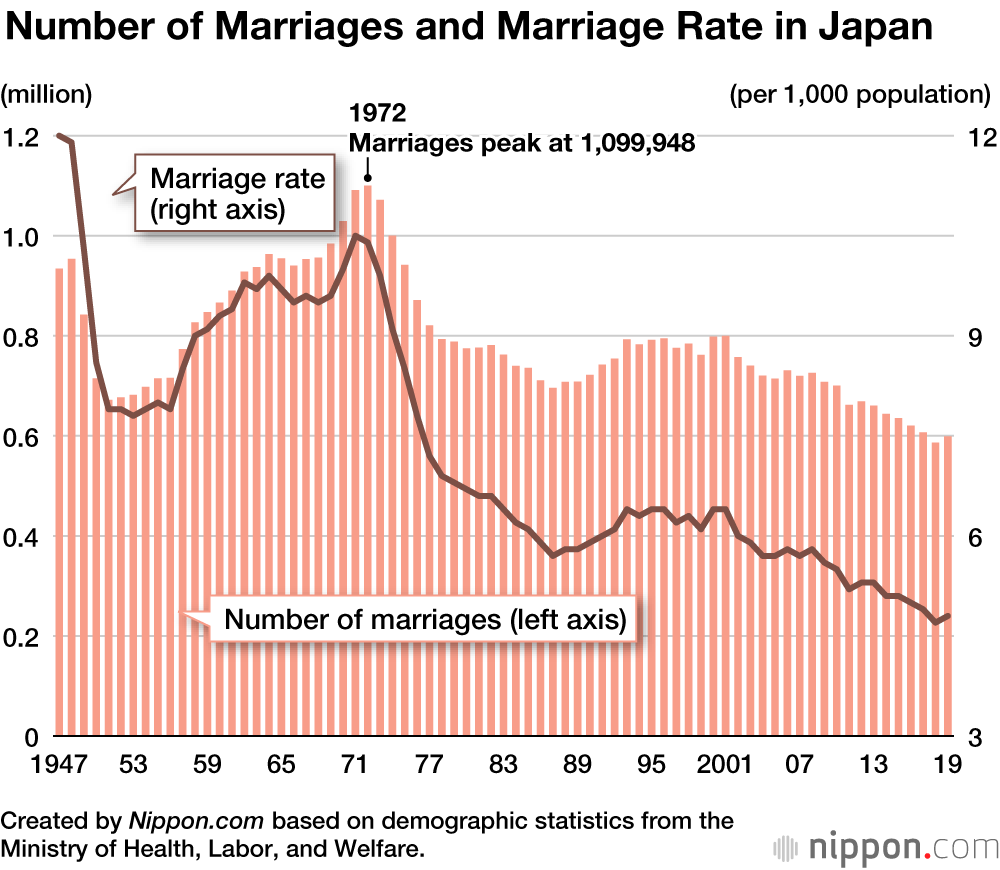
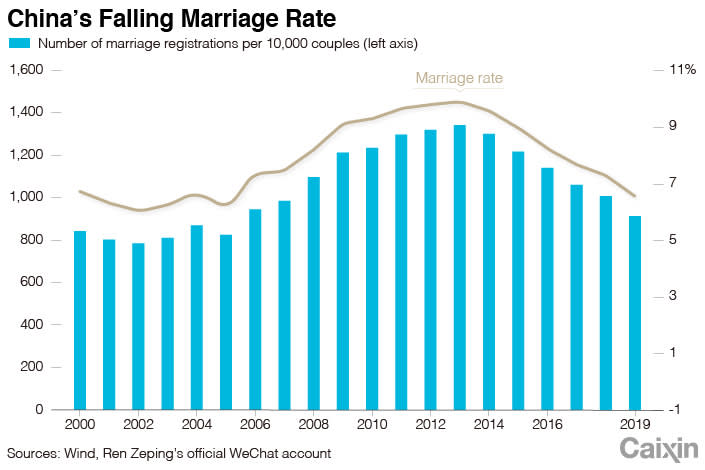
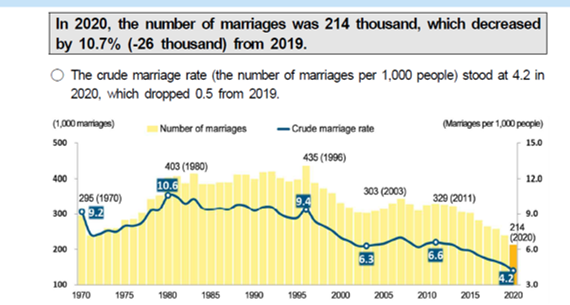
data from :
https://www.nippon.com/en/japan-data/h00759/
http://kostat.go.kr/portal/eng/pressReleases/8/11/index.board
https://asia.nikkei.com/Spotlight/Caixin/How-Chinese-fell-out-of-love-with-marriage
When talking about this declining rate In, at first I thought this phenomena occurs because currently japan economic became stagnant. So, couple was afraid to engage in marriage. But, this hypothesis soon could be denied after we knew the fact that Korean and China economic became increasing, but still the number on people who get married in those countries which sharing similar culture with Japan, become declining. Or maybe I suspect, we were not digging enough when discussed on this point. For the example, yes their economic (China, Korean) is rocketing but for their people expends, they still need more income to have a stable life in their marriage life compare with their parents time.
Is it because free sex?
My second hypothesis, may be this is happened because the free sex is not a taboo anymore. Compare in Showa era, maybe it is easy to fulfill the desire of sex by going to any entertainment shop. But again this hypothesis soon be denied because in Tokyo University press release mentioned that Japan might be leading a global trend of more people not having sex. Boom… you must be wrong also until this time…
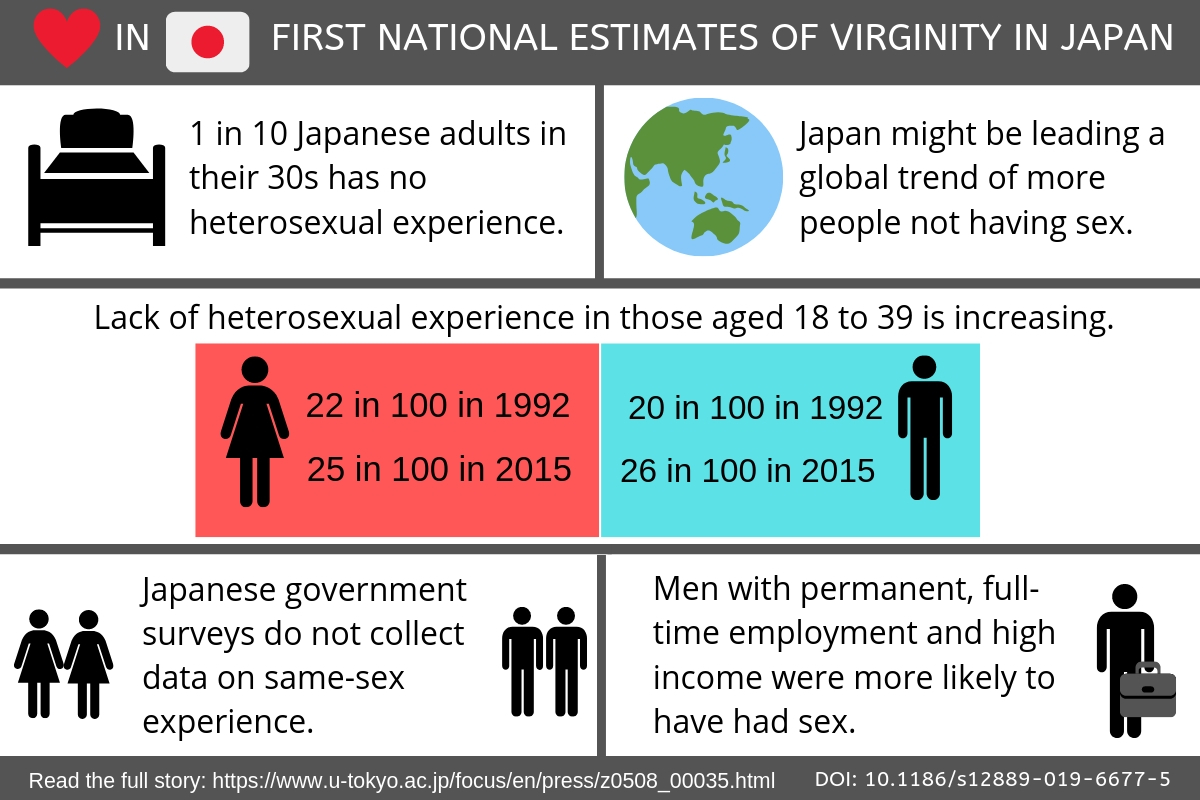
https://www.u-tokyo.ac.jp/focus/en/press/z0508_00035.html
Maybe because Japanese women is not interested with Japanese guy so it is difficult to them to get married
If we would like to blame the Darwin’s natural selection law, maybe we can bringing out this issue. Currently the number of female than male in japan is quite different. In that discussion, I was suspecting that it is difficult for Japanese man to get the ladies that touch his heart. Because their number is few. So, the competition between man to get their woman become higher than before. as natural selection, Who cant attract the woman that they like, they should accept the live that they cant get married with her (well this is just my analogy). But dang.. we were wrong, the male population in Japan is lower than the female population. (Japan has 126,459,481 people in total, with male population is : 48,7% and female population is : 51,3%). https://countrymeters.info/en/Japan. Well, actually my colleague was also commenting that this point of view was shallow.
It is a silent retreat resistance
It is one of the people movement to protest to the government, because Japanese doesn’t have freedom to tell what is their thinking. By not getting married, means they make the chance to having a babies also decline, and it will be affected to the number of Japanese population in the future. This is their silent retreat. Well, this is not my hypothesis, but the information that has been told by my colleague. I told him that that Idea is just not make sense for me, because is that heroism act really occur in all man who did not getting married in Japan?
Well, my collegue just correcting me about my understanding in this part. As he said,
I should use the word “resistance” instead of “retreat.” (pardon me for my mistakes). In his definition regarding this movement, the people who suffer from ‘low income’ or ‘poor job availability’ and who do not fit into ‘old-school customs’, may conduct a silent resistance against this hyper-conservative and unfair society. People don’t try to resist because they themselves are not aware of it. But an impact is as strong as the society must change anyway.
Currently in Japan reality, there are A lot of unmarried people even work harder for this society than married people. So this unmarried people seems contribute more than the married people. Society supposed to not see their choice as a wrong choice. And this movement could be reason for Japan society why the marriage rate is declining.
Closure
Since the clock keep ticking and the storm almost stop and the sky became darker we politely close our discussion by taking a short conclusion that, we can not see the problem in only one aspects. We still not discuss the effect of this declining marriage rate in Japan. Will the declining of married rate in Japan will bother Japan economic situation or will the society become better when the number of married compare is changed . May be the discussion will be continued when there is a sudden storm attack again. Who knows..
Anyway if you want to share your thought about Japan declining marriage phenomena, you can contact me, and I will invite you to discuss in my podcast.
what makes us who we are? lets explore it!
 PhD's Notes
Leave a comment